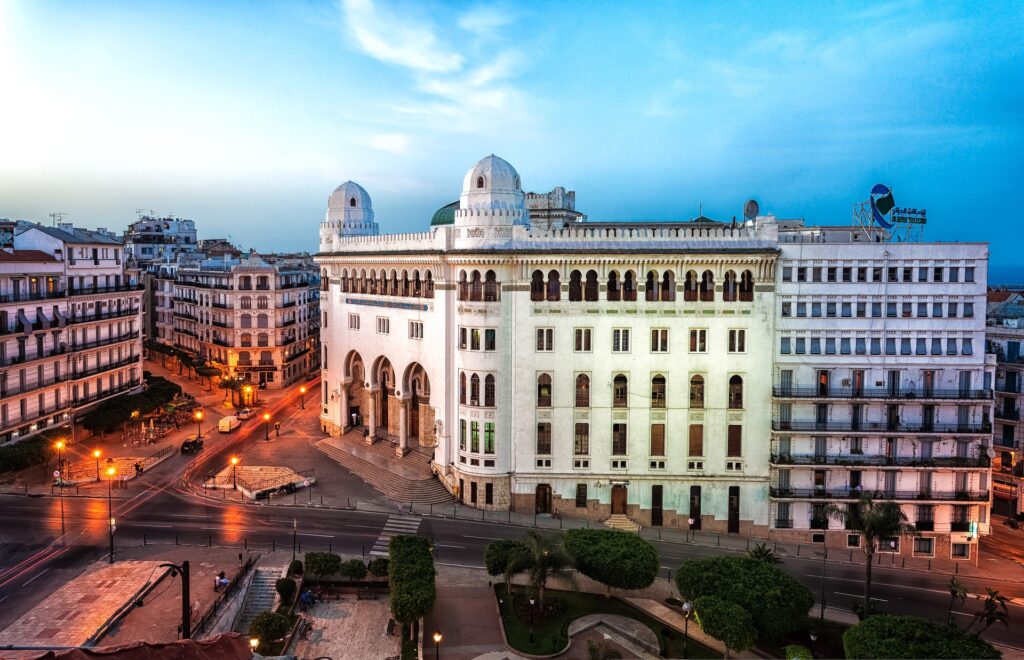
Its white silhouette, majestic bay, and diverse neighborhoods give Algiers an immediately recognizable identity. Here, the palaces of the Casbah stand alongside the buildings of the seafront, Neo-Moorish structures, modernist creations, and major contemporary projects.
Yet Algiers does not reveal itself at first glance. You need to explore it on foot, climb toward its heights, cross its markets, observe its façades, and stop in its gardens to understand a city shaped by more than two thousand years of history.
Algiers, a History Open to the Mediterranean
Shaped by more than two thousand years of history, Algiers rises like an amphitheater facing the Mediterranean. From the port to the neighborhoods on the heights, its sloping streets, stairways, and balconies offer numerous views over the bay. This constant relationship with the sea encouraged exchanges and made the city a strategic crossroads between Africa, Europe, and the Mediterranean world.
The history of Algiers goes back to ancient Ikosim, which became Icosium during the Roman period. In the tenth century, Bologhine At Ziri refounded the medieval city, known as Dzair At Mazghana. From the sixteenth century onward, Algiers became the capital of a regency linked to the Ottoman Empire and established itself as an important maritime power.
The Casbah, listed as a UNESCO World Heritage Site, preserves the memory of this period. Its narrow streets, covered passageways, houses with patios, palaces, and mosques form an exceptional heritage. Dar Aziza, Mustapha Pacha Palace, Ketchaoua Mosque, and the Palace of the Rais are among its emblematic monuments.
From 1830 onward, the city underwent profound transformations. New boulevards, buildings with arcades, and monumental structures reshaped the city center and the seafront. The Grande Poste, a famous example of Neo-Moorish architecture, became one of the capital’s symbols.
Modern architecture and buildings constructed after independence later enriched the urban landscape. The works of Fernand Pouillon, the Martyr’s Memorial, the El Aurassi Hotel, Djamaa El Djazair, and the Algiers Opera House bear witness to this continuing evolution.
Discovering Algiers means traveling through different eras: exploring the Casbah, admiring the arcades of the seafront, walking through the Hamma Test Garden, and then heading toward the heights to contemplate the bay. Ancient, Amazigh, Ottoman, colonial, and contemporary, Algiers reveals a plural, vibrant, and deeply Mediterranean identity.
An Algiers Walk